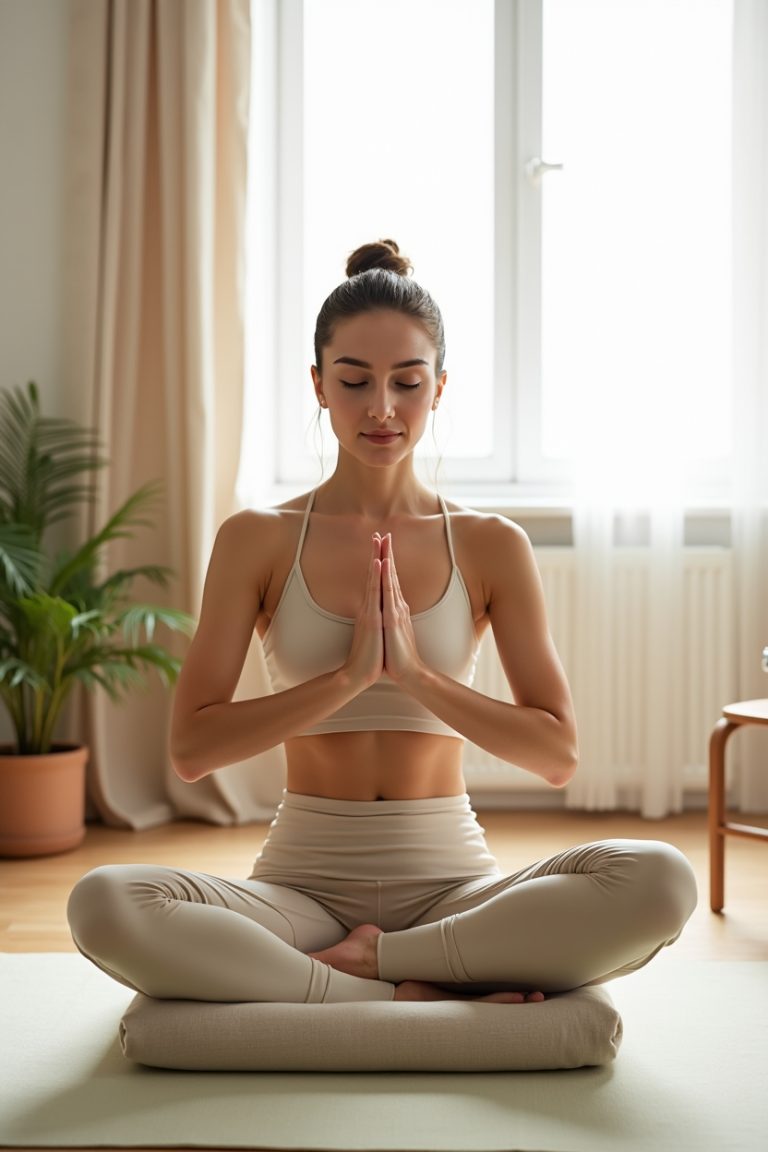
Hatha Yoga for Sleep for Writers: A Gentle, Pinterest-Friendly Guide
Late-night drafts, deadline adrenaline, and a mind that keeps returning to the same sentence — many writers know how sleep can feel elusive. Irregular hours, blue-light exposure, and habitual mental rumination conspire to keep you awake. That is where a calm, routinized practice can help.
Hatha yoga for sleep for writers offers accessible breath and restorative practices that meet the creative brain where it is. This article explains the hatha principles that support sleep, gives detailed breath techniques and soothing poses that are gentle after long hours at a desk, and shows how to build a sustainable nighttime ritual you’ll actually keep returning to.
How Hatha Yoga Supports Sleep: Core Concepts
Hatha is less a rigid set of moves and more a balanced approach — breath, body, and calming rituals that coax the nervous system toward rest. Below are the practical hatha ideas most relevant to sleep and to the writer’s habit of carrying storylines into the night.
Concept: Balancing Ida and Pingala for Nervous System Calm
**Ida** and **Pingala** are names from classical energetic maps — think of them as metaphors for the body’s cooling, restorative side and the activating, doing side. Hatha practices aim to bring these currents into a relaxed dialogue, which you’ll notice as a softer breath, a reduction in inner urgency, and less mental ping-pong between ideas.
On a practical level, balancing these channels translates to lowering sympathetic (fight/flight) tone and encouraging parasympathetic (rest/digest) responses. For you as a writer, signs of this balance include fewer intrusive thoughts when you try to sleep, less neck-and-shoulder tightness after a long editing session, and a steadier breath through your exhale.
You don’t need to adopt complex rituals to benefit — simple breath alternations, gentle lateral stretches, and longer exhales are the most direct ways to invite that calm. They aren’t mystical; they are cues your nervous system reads as permission to downshift.
Concept: From Effort to Ease — Tapas vs. Sattva in an Evening Practice
Two Sanskrit words help explain why your evening practice feels different than your morning or midday session. **Tapas** refers to focused effort and discipline — excellent for deadlines and morning energy. **Sattva** refers to clarity, balance, and ease — the quality you want before sleep.
For a bedtime practice, the intention is to move from tapas to sattva: reduce muscular striving, shorten peak heart rate, and favor long, supported postures. That shift helps your body translate the psychological sign-off of closing work into physiological rest.
A simple rule: if a pose or breath increases alertness or tension, soften it. Replace active holds with supported versions, prioritize slow diaphragmatic breathing, and choose stillness over flow when the goal is sleep.
Concept: Breath as a Bridge — Why Pranayama Matters for Sleep
Pranayama — the yogic art of breath regulation — is the bridge between mental habits and autonomic physiology. Slow, coherent breathing lowers heart rate, shifts vagal tone, and can bring the mind’s chatter into a rhythm that lulls the nervous system.
Physiologically, practices that elongate the exhale and encourage diaphragmatic movement improve heart rate variability and promote sleep onset. For writers, breath work interrupts the loop of reviewing scenes, edits, or worries: it gives you an immediate tool to return to the present moment, without judgment.
Begin with short, regular practices — even three minutes before bed — to make the breath a dependable cue that the day is ending.
Breath Techniques from Hatha for Writers’ Bedtime (hatha yoga for sleep for writers)
Targeted pranayama can be the fastest, most portable way to shift a busy creative mind toward rest. Each technique below includes why it works, contraindications, and a brief how-to you can use on writing nights.
Nadi Shodhana (Alternate Nostril) — Why It Quietens the Mind
**Nadi Shodhana** — alternate nostril breathing — calms the mind by creating a balanced, rhythmic breath pattern and by reducing scattered attention. Its alternating quality is especially helpful after a writing sprint when ideas keep vying for attention.
Contraindications: avoid forceful breath or breath retention if you have cardiovascular or severe respiratory conditions; practice gently and comfortably. If you are congested, use a softer approach or choose another technique.
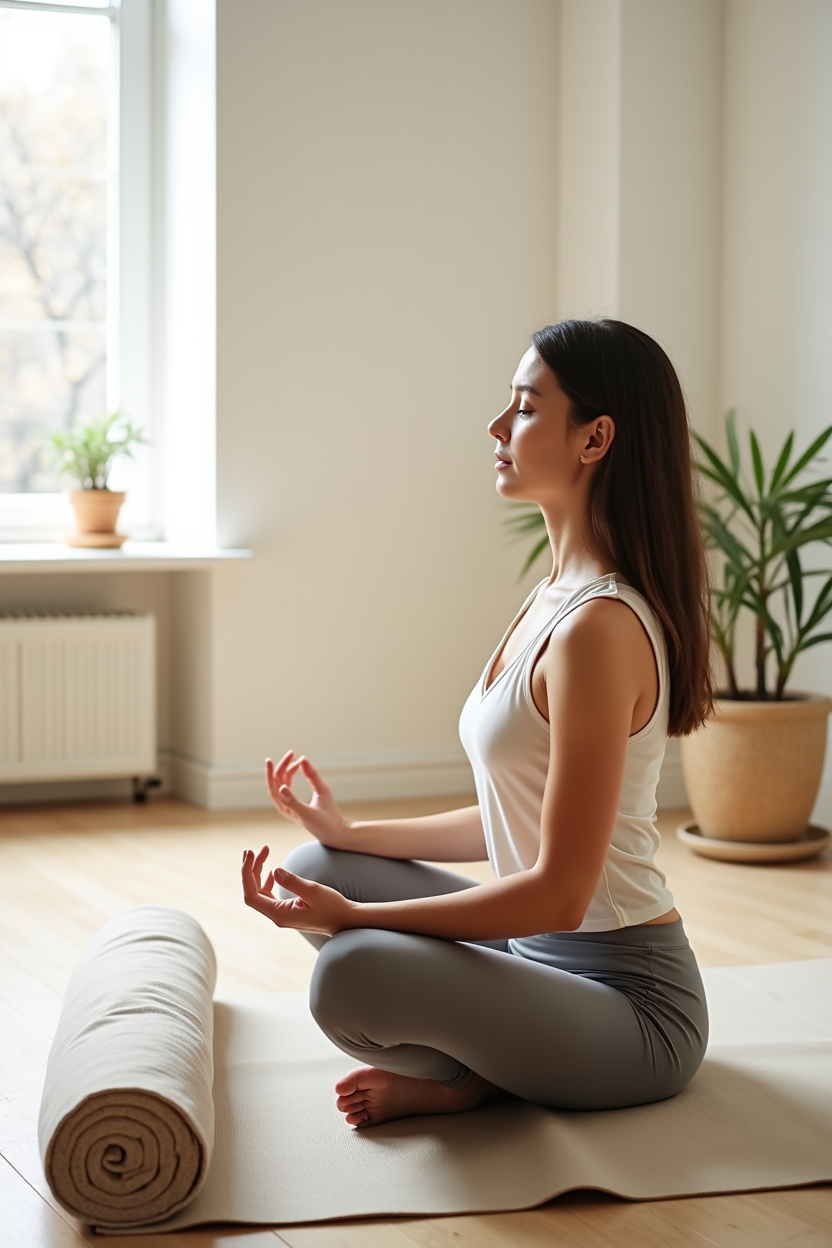
How-to (3 minutes): Sit comfortably. Use your right thumb to close the right nostril and inhale through the left. Close the left with your ring finger, open the right and exhale. Inhale through right, close, then exhale through left. Keep breaths smooth and slightly longer on the exhale. Repeat for 6–12 cycles, or about three minutes, allowing each cycle to slow and settle your mind.
- Find a comfortable upright seat with a soft gaze.
- Right thumb closes right nostril; inhale left.
- Close left with ring finger; open right and exhale.
- Inhale right, close, exhale left — repeat 6–12 cycles.
4-6-8 or Coherent Breathing — Resetting Heart Rate Variability
Simple counted breath patterns quickly influence heart rate variability and the balance between sympathetic and parasympathetic systems. The 4-6-8 pattern or a coherent 5-5 rhythm are easy to remember and effective.
Why it helps: longer exhalations signal safety to the vagus nerve, slowing the heart and smoothing the mind. Writers often benefit from a predictable rhythm that interrupts rumination and anchors attention.
Practice suggestion (rapid transition to sleep): Lie down or sit with support. Inhale for 4, pause briefly if comfortable, exhale for 6–8. Repeat for 4–10 minutes, keeping the breath gentle and through the nose if possible. If counting adds pressure, switch to a soft mental phrase on the exhale.
- Set a gentle timer for 5–8 minutes.
- Inhale 4 counts (softly), exhale 6–8 counts.
- Focus on lengthening the exhale rather than making inhales large.
- Stop if you feel lightheaded; return to normal breathing.
Sheetali/Sheetkari Variants — Cooling the Overactive Mind
**Sheetali** and **Sheetkari** are cooling breath practices that can reduce agitation after intense creative sessions or arguments with your inner critic. They are mild and pleasant when done gently.
When to use: if you feel physically hot, flushed with adrenaline, or mentally agitated. Avoid these if you have high blood pressure or dental issues without medical advice, and always keep the breath soft.
How-to (mild variant): Sit comfortably. For Sheetali, curl the tongue into a tube and inhale through it, then exhale through the nose. For Sheetkari, part the teeth slightly and inhale through the teeth, exhale through the nose. Keep the inhalation easy and the exhale natural. Practice for 1–3 minutes, then return to normal breathing.
- Choose the milder Sheetkari if you cannot comfortably tube your tongue.
- Inhale gently through the mouth shape; exhale through the nose.
- Keep practice brief — 1 to 3 minutes — and return to normal breath.
Restorative & Gentle Hatha Poses That Ease Sleep for Writers
After hours at a desk the neck, shoulders, and chest accumulate tension — and the mind holds story threads. These slow, supported hatha shapes are designed to let tension dissolve while you breathe into release.
Supta Baddha Konasana (Reclining Bound Angle) — Soften the Chest and Hips
**Supta Baddha Konasana** — reclining bound angle — is a wonderfully supported pose for opening the hips and chest without strain. It counteracts the rounded posture of long typing sessions and invites a long, steady exhale.
Setup and modifications: lie on your back with the soles of the feet together and knees wide. Support your knees with bolsters or folded blankets if your hips are tight. Place a rolled towel under your head if that helps your neck.
Breath focus for 5–10 minutes: notice the belly rising gently on the inhale and the belly settling on the exhale. If hips are very tight, keep the feet further from the pelvis and support the knees higher.
- Props: bolster or folded blanket under knees; blanket under head as needed.
- Modification: move feet further from pelvis for less hip intensity.
- Duration: 5–10 minutes with soft diaphragmatic breath.
Supported Forward Fold for Neck and Shoulder Release
A gentle, supported forward fold lengthens the posterior chain and gives immediate relief to a tight neck and shoulders. The forward curve encourages the diaphragm to relax and the head to release.
How to set up: sit on the floor with legs extended or on a chair if that’s more comfortable. Fold forward over a bolster or pillows so the torso is supported and the neck can soften. Let the arms rest wherever they land.
Practical cues: soften the jaw, allow the breath to be slow and even, and stay for 3–8 minutes. For screen-induced tension, this posture helps move blood away from the head and signals the nervous system that performance mode is ending.
- Use a bolster or stack of pillows to support the torso.
- Keep knees slightly bent if hamstrings are tight.
- Hold 3–8 minutes, breathing softly into the back body.
Legs-Up-the-Wall (Viparita Karani) — A Classic Hatha Option for Sleep
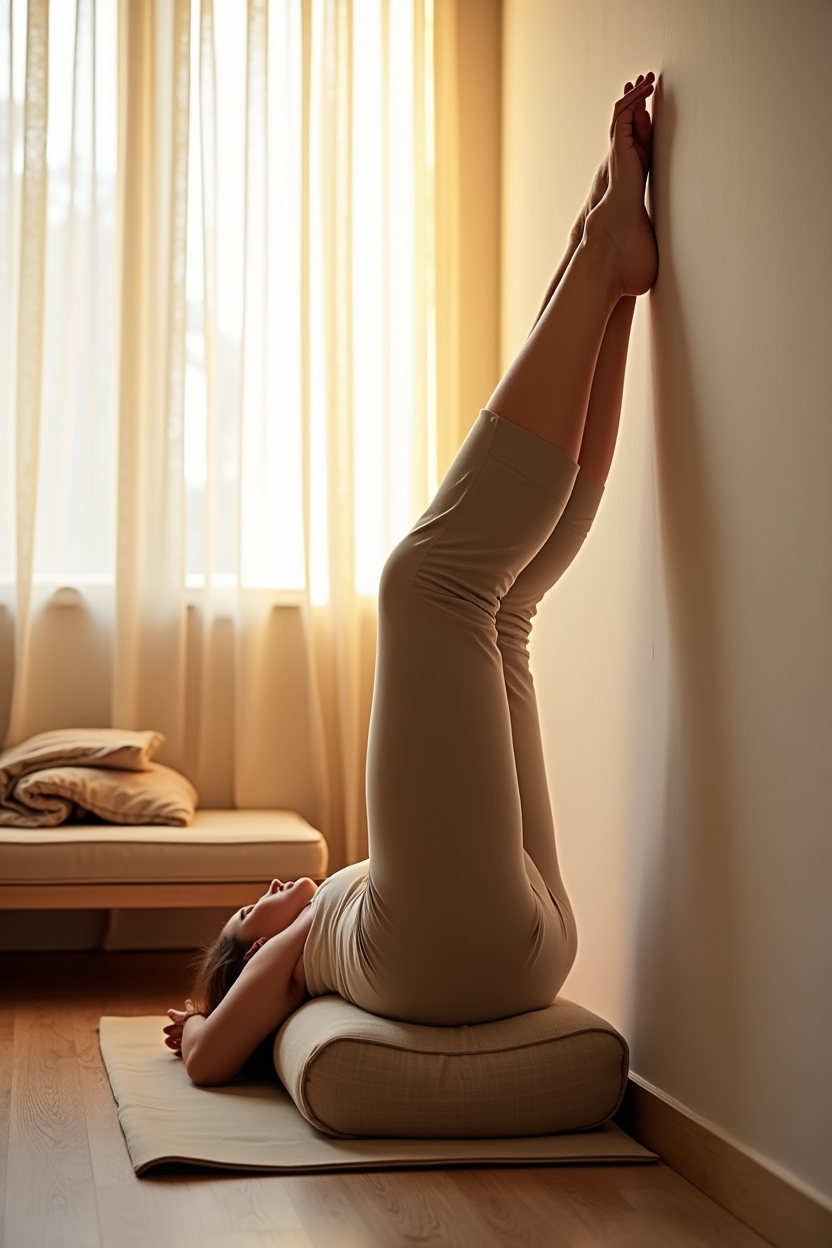
**Viparita Karani**, legs-up-the-wall, is gentle, accessible, and powerful for circulation and nervous-system regulation. It reduces lower-body tension and invites a restorative shift toward parasympathetic response.
Timing and duration: practice for 10–20 minutes in the hour before bed. It’s especially helpful on nights when you’ve been on your feet or when creative anxiety keeps your legs restless.
How it affects you: the mild inversion encourages venous return, calms the mind, and provides a buoyant place from which to do breath work or a short body scan.
- Set up with hips close to the wall and a folded blanket under the sacrum if you want extra lift.
- Keep knees soft; feet relaxed against the wall.
- Practice 10–20 minutes for restorative benefit.
Savasana with Guided Body Scan — The Hatha Close for Writers’ Rest
**Savasana** — final relaxation — is the essential close. Instead of a rushed lie-down, a 10–15 minute guided body scan helps you witness sensations without editing them, a different mode than the analytic mind uses while writing.
Structure for 10–15 minutes: settle into a comfortable supine position, use a light blanket, and begin a gentle scan from the feet to the crown. Spend 20–60 seconds on each region; invite the breath to lengthen the exhale in each area you rest on.
Common obstacles and solutions: mental chatter will arise. When it does, steer gently back to the sensations in one small area — the right big toe, the left shoulder blade — and use the breath as an anchor. If sleep comes, that’s fine; allow it.
- Lie comfortably with supports as needed and a light blanket over you.
- Begin by noticing the feet, then scan slowly up through the legs, pelvis, torso, arms, neck, and head.
- Spend 10–15 minutes; if the mind wanders, bring attention back to a single area.
Sequencing Principles: A Hatha Nighttime Flow for Writers
A well-ordered practice honors the nervous system’s need to cool, ground, and soften. Small choices in sequence — breath first, then movement, then stillness — make your ritual more effective and easier to repeat.
Why Order Matters — Cooling, Grounding, and Softening
Order matters because each part of the practice prepares the next. Start with breath to slow the mind, move through gentle asana to release physical tension, and finish with supported restorative poses and savasana to seal the nervous-system response.
For writers, this progression also mirrors psychological closure: you move from the active thinking state (breath + gentle movement) into the receptive rest state (supported poses + relaxation). Practicing in this order communicates clearly to your body that the workday has ended.
Small timing note: if you’re practicing immediately after a caffeine-heavy session or a late email, give yourself a few calming minutes after the breath before entering longer holds.
How to Create a 10‑Minute Rapid Practice
A 10-minute wind-down is ideal for busy evenings. The goal is a compact sequence that reliably lowers heart rate and reduces neck/shoulder tension while fitting into a writer’s evening.
Sequence (why/how): begin with one to two minutes of coherent breathing to anchor the mind (why: sets parasympathetic tone; how: 4–6 exhale pattern). Move through gentle seated twists and shoulder rolls for 2–3 minutes to release trapped tension (why: creates space in the torso; how: slow, supported movements). Finish with 3–4 minutes of legs-up-the-wall and a short, two-minute savasana or body scan (why: restorative closure; how: use props and keep breaths long). This minimalist flow respects both time and nervous-system needs.
- 1–2 min: coherent breath (4–6 exhale)
- 2–3 min: gentle seated twists and shoulder releases
- 3–4 min: legs-up-the-wall
- 2 min: short savasana or body scan
How to Expand to a 25‑Minute Ritual
When you can, extend the ritual to allow deeper processing of creative residue. A longer practice gives you more pranayama, longer supported holds, and space for journal prompts that help settle the mind.
Structure and reasons: begin with 3–5 minutes of alternate nostril and coherent breathing (why: deeper autonomic balance; how: Nadi Shodhana followed by coherent counts). Add 8–10 minutes of supported forward folds, Supta Baddha, and gentle hip openers (why: release stuck tension; how: use bolsters and hold for 2–5 minutes each). Finish with 7–10 minutes of legs-up and an extended 5–7 minute savasana with a guided body scan or a short journaling/intent-setting practice to externalize leftover thoughts.
Journaling suggestion: keep it time-boxed (3–5 minutes) and focused on a quick brain dump or one sentence of closure — this helps the body follow the psychological end-of-day signal.
- 3–5 min: combined Nadi Shodhana + coherent breathing
- 8–10 min: supported asana holds (Supta Baddha, forward fold)
- 7–10 min: legs-up + extended savasana
- 3–5 min: optional time-boxed journaling before or after practice
Lifestyle, Environment, and Mindset: Beyond the Mat for Better Sleep
Yoga is most effective when paired with gentle environmental and behavioral shifts. Small, low-tech changes amplify the mat work and help you inhabit a sleep-friendly evening.
Evening Writing Rituals that Complement Hatha Practice
Finish writing with intention, not a sudden stop. A brief brain dump or a written ‘parking lot’ for next-day ideas lets your mind release story threads and accepts that they’ll be safe for tomorrow.
How it supports the practice: when your mind is less busy, breath work and restorative poses can do their job more quickly. This is where yoga for writers’ sleep becomes practical — the combination of time-boxed ending, breath, and movement creates a ritualized signal for rest.
Simple ritual: set a hard stop time, spend 3–5 minutes writing a one-paragraph summary of where you left off and three next steps, then move to your breathing or posture sequence. Repeating this ritual trains the brain to expect closure.
- Time-box the final 10–15 minutes of your writing.
- Do a 3–5 minute brain dump or next-steps list.
- Transition immediately into breath work or the 10-minute practice.
Creating a Calming Sleep Environment
Make small, affordable adjustments: dim lights an hour before bed, lower the screen brightness, and favor warm, soft textiles. A slightly cooler room temperature supports sleep for many people.
Bed vs. floor: practice on the floor when you want better alignment and deeper restorative benefit. Practicing on the bed can be soothing for quick breath work and very restorative poses, but the floor provides steadier support for poses like Supta Baddha and supported forward folds.
Practical tech note: use an evening reminder or a dimming lamp to cue the beginning of your ritual so it becomes predictable and easier to follow consistently.
- Dim lights 60 minutes before bed; consider a warm bedside lamp.
- Lower room temperature slightly (comfortable cool).
- Practice on the floor for deeper restorative benefit; use the bed for brief breath sessions if needed.

When to Seek Professional Help
Yoga is supportive but not a replacement for medical care. If insomnia persists for weeks, if you experience severe anxiety, depression, or if sleep problems interfere with daily functioning, reach out to a clinician.
How to integrate care: let your healthcare provider know you practice hatha yoga and the breathing techniques you use. Yoga pairs well with cognitive-behavioral therapy for insomnia and with many medical treatments when recommended by a professional.
Red flags to watch for: consistent inability to fall asleep or stay asleep, daytime impairment, or mood changes. These call for evaluation rather than more self-directed practices alone.
Sample Practices & Pinterest-Friendly Graphics to Save
Below are two ready-to-pin practice cards you can save or print: a compact 10-minute wind-down for busy nights and a fuller 20-minute ‘Deep Unplug’ for when you have more time. The card titles use the phrase hatha yoga for sleep for writers to make them discoverable on visual platforms.
Card A — 10‑Minute Writer’s Wind-Down (quick hatha yoga for sleep for writers)
This compact sequence is perfect for weeks when you need a reliable ritual. It moves from breath to short movement to restorative rest, and is easy to render on a Pinterest card with simple icons and timestamps.
Steps and timing: 1–2 minutes coherent breathing; 2 minutes seated twists and shoulder releases; 3–4 minutes legs-up-the-wall; 2 minutes short savasana with a mini body scan. Keep the language on the card brief — e.g., “Breathe 4:6, twist gently, legs-up 3 min, rest 2 min.”
Caption for a pin: “Quick hatha yoga for sleep for writers — 10 minutes to quiet the mind and soften the shoulders. Save this for late nights.”
- 1–2 min: Coherent breathing (inhale 4, exhale 6)
- 2 min: Gentle seated twists + shoulder rolls
- 3–4 min: Legs-up-the-wall (Viparita Karani)
- 2 min: Short savasana with a 1-minute body scan
Card B — 20‑Minute Deep Unplug
This longer card is designed for evenings after heavy creative work. It allows more time for breath and longer restorative holds — ideal for a weekend or a night when you can be gentle with your schedule.
Suggested flow: 3–4 minutes Nadi Shodhana followed by 5–7 minutes of supported forward fold and Supta Baddha holds, 5–7 minutes legs-up-the-wall, and a 5-minute savasana with a guided body-scan cue. Include a short journaling prompt on the card: “One sentence of closure.”
Pin caption idea: “20-minute Deep Unplug: longer breath, longer holds, deeper rest — a hatha yoga for sleep for writers ritual.”
- 3–4 min: Nadi Shodhana (alternate nostril)
- 5–7 min: Supported forward fold + Supta Baddha
- 5–7 min: Legs-up-the-wall
- 5 min: Savasana with guided body scan and 3-minute journal prompt
Download: Writer’s Nighttime Yoga Card (Printable, Two-Sided)
A printable two-sided card you can tuck by your bedside. Front: the 10-minute sequence with icons and timings. Back: quick breath exercises and a short savasana script to read aloud or follow silently. Low-tech, beautiful, and usable every night.
Get the Printable Card
Final Thoughts
Hatha yoga for sleep for writers is not a cure-all — but it can be a simple, steady ally. Small rituals that combine supportive breath, gentle poses, and a mindful end to your writing work help retrain the nervous system to close the day with ease.
Experiment with timing and length, be kind to the process, and keep the practice accessible. If you like, save or print the provided cards and let them remind you that rest can be intentional and gentle.