How to Improve Sleep with Knees Stretches: A Gentle Guide
Sleep depends on far more than tiredness — it depends on comfort. Small tensions in your knees, calves and hips can keep you shifting all night, so learning how to improve sleep with knees stretches can make a real difference. This guide offers clear, gentle practices, safety notes, and a short routine you can try tonight to calm legs and invite steadier rest.
You’ll learn why knee and lower-leg tension matter for sleep, how to prepare safely, six restorative knee-focused stretches with cues and modifications, and a 10-minute bedtime sequence to ease into rest. Use the single-session routine as a nightly ritual or the longer option when you need deeper release.
Why knee tension matters for sleep
Knee and lower-leg tension is often overlooked when we think about sleep. Discomfort anywhere along the leg can ripple up the chain — changing how you lie down, how often you turn, and how easily your nervous system settles.
Anatomy in plain language: knees, hips and sleep posture
Think of the knee not as an isolated hinge but as a link between hip, thigh and lower leg. The quadriceps at the front of the thigh, the hamstrings at the back, the calves and the iliotibial (IT) band all influence how the knee tracks and how comfortable it feels when you lie down. Tight quads can pull the kneecap; stiff hamstrings can create posterior pull into the back of the knee; a tense IT band can tug on the outer knee during side-lying positions.
Your preferred sleep posture — back, side, or stomach — interacts with these tissues. For example, side sleepers who keep the top leg un-supported may feel increased pull through the outer thigh and knee. Even small imbalances can cause repeated micro-adjustments during the night, interrupting deep sleep cycles. Framing the knee within this whole-leg system helps you choose stretches that support comfortable alignment rather than forcing range.
How tension becomes wakefulness
Tight tissues register as sensory input. During sleep, your nervous system remains responsive to signals of discomfort so it can protect you — a tense calf or a pinched area near the knee can trigger micro-awakenings or a shift in position. Over time these small interruptions fragment sleep architecture and reduce restorative slow-wave and REM cycles.
A common pattern: after a long day on your feet you settle into bed but keep needing to change sides or flex your knee. The next morning you feel unrested despite a normal duration of sleep. Addressing the peripheral tension with gentle stretches and calming breath reduces those sensory alarms and gives your nervous system less reason to interrupt deep sleep.
Preparing safely: alignment, breath, and timing
A little preparation keeps the stretches helpful rather than irritating. Set up a calm space, check in with pain vs. ache sensations, and plan timing — 10–30 minutes before bed is ideal for winding down.
Quick safety checklist
Before you start, do a brief self-check. Pain that feels sharp, pins-and-needles, or causes swelling is a signal to stop and, if it persists, consult a clinician. A gentle ache, a sense of stretching without sharp edges, or a warm release are more typical sensations for restorative work.
If you have diagnosed knee instability, recent surgery, or advanced osteoarthritis, adapt by decreasing range, using more support, or replacing stretches with isometric holds under professional guidance. When in doubt, choose comfort and small movement over depth.
- Avoid sharp, shooting pain—stop and rest if it appears.
- Distinguish ache (ok) from numbness/tingling (seek advice).
- Use props to reduce compression (bolster, folded blanket).
- If you’re post-op or have advanced arthritis, check with a clinician first.
Props and setup for comfort
Simple props make these stretches accessible in bed or on a yoga mat. A firm bolster or a stack of pillows supports the spine in reclined positions; a yoga strap or belt helps you draw a knee to chest if your hands can’t reach; a folded blanket under the knee reduces pressure when you need minimal load. A block or small pillow under the hip in reclined figure-4 keeps the pelvis level and removes tugging on the knee.
Arrange your space so you can move slowly without searching for props mid-stretch. Low lighting and a warm blanket enhance relaxation; breathable clothing avoids constriction. These tiny comforts invite your nervous system to downregulate along with the muscles.
- Bolster or firm pillow for under the back
- Strap or long scarf for knee-to-chest and figure-4
- Folded blanket for under knee or ankle support
- Block or small pillow for hip support in reclined poses
Breath and small movement to settle the nervous system
Breath is the bridge between body and nervous system. Before you stretch, practice a slow 4-6 breath cycle: inhale slowly for a count of 4, exhale for a count of 6. Lengthening the exhale calms sympathetic arousal and prepares tissues to soften.
Combine gentle movement with breath — a few mindful knee bends or ankle circles timed to your exhale help the joint find a comfortable rhythm. This prepares both muscles and mind, which is especially helpful when the goal is better sleep rather than increased mobility.
- Find a comfortable reclined position.
- Inhale for 4 counts through the nose.
- Exhale for 6 counts through the nose or mouth.
- Repeat 6–8 times, coordinating small knee movements to the exhale.
How to improve sleep with knees stretches — core poses
Below are six gentle, knee-focused stretches suitable for bedtime. For each, move slowly, breathe calmly, and prioritize ease over depth. These are intended to reduce leg tension that interrupts sleep.
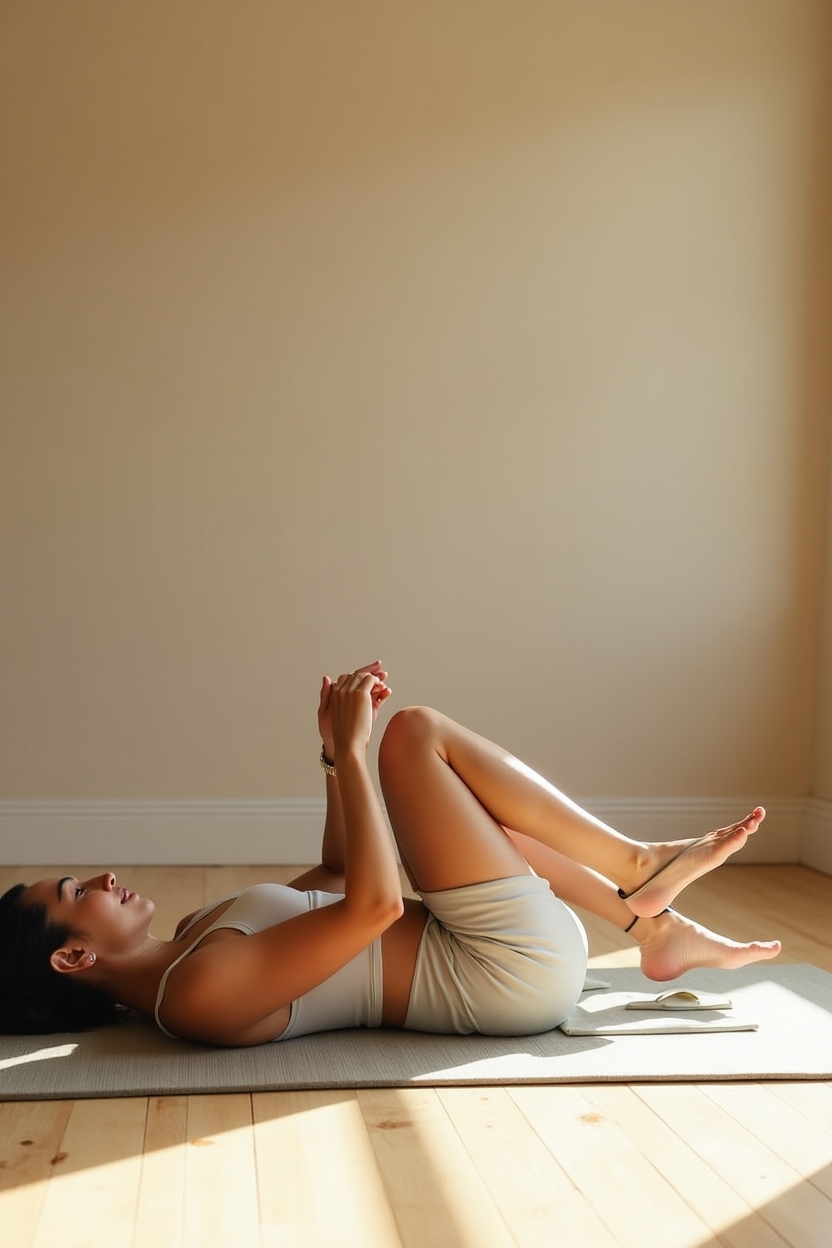
Supported knee-to-chest (single)
How: Lie on your back with a support under your head and a blanket under the hips if helpful. Bend one knee and draw it toward your chest using your hands or a strap looped around the shin, keeping the opposite leg long and relaxed. Keep the knee aligned and avoid pulling the neck forward.
Why: This gentle hip and lower-back release reduces posterior chain tension that can transmit to the knee. Timing and modifications: hold 1–2 minutes each side; if the knee resists, keep the opposite knee bent or use the strap to reduce grip. Expect a softening around the lower back and a gentle release behind the knee.
Reclined figure-4 with support
How: From supine, cross the ankle of one leg over the opposite thigh, forming a loose figure-4. If needed, place a block or pillow under the crossed knee or thread a strap behind the standing leg’s thigh to bring the leg closer. Keep both sit bones grounded and the spine neutral.
Why: This opens the outer hip and IT band — areas that can pull on the knee when tight. Hold 1–3 minutes per side, breathing into the outer hip. If the knee feels compressed, use a higher pillow under the hip or reduce the angle until the sensation is a mild stretch rather than pressure.
Knee folds in child’s pose (gentle)
How: From a kneeling position, sit back toward the heels and lower the torso toward the thighs for a gentle child’s pose. Widen the knees if that feels better for the hips, or keep them together if you prefer more support. Optionally, make small, slow knee bends (fold and return) synchronized with the exhale to invite circulation.
Why: This posture gives a soothing, compressive sensation around the knees without deep flexion, helping joint comfort and calming the nervous system. Hold for 1–3 minutes, using breath to soften into the pose. Use cushioning under the shins or between the calves and thighs if direct contact is uncomfortable.
Seated hamstring release with bent knee
How: Sit on a cushion with one leg extended and the other knee slightly bent toward the inner thigh. Keep a micro-bend in the extended knee if full straightening is uncomfortable. Hinge from the hips with a long spine and reach toward the shin or a strap looped around the foot. Avoid rounding the lower back.
Why: Tight hamstrings increase posterior pull through the knee; gently releasing them can reduce strain. Hold 1–2 minutes per side, focusing on a softening rather than forcing length. If reaching is limited, use a strap and stop at a point of mild, even tension.
Ankle-to-knee rotation and calf softening
How: From seated or supine, draw the ankle to the knee and make gentle circular motions at the ankle, then massage the calf muscle with your hands or a soft ball. Spend time exploring tender spots with light pressure and long breaths, and include ankle circles in both directions.
Why: Calf and ankle tightness change how the knee tracks and can send discomfort upward. Releasing the distal tissues reduces compensatory tension that disturbs sleep. Keep movements small and rhythmic, and stop if you feel sharp pain.
Supported supine knee hinge (minimal load)
How: Lie on your back and practice heel slides: slowly slide one heel toward the buttock, bending the knee slightly, then slide it back. Place a folded blanket under the knee if the joint needs cushioning. Keep movement slow, coordinated with a calm breath.
Why: These small, supported knee hinges encourage mobility without compression, preserving joint comfort while increasing circulation and proprioceptive reassurance. Do 8–12 slow repetitions per side as a gentle joint reset before bed.
How to improve sleep with knees stretches — a 10-minute bedtime routine
A short, consistent ritual helps your body learn a new pattern: less leg tension, fewer micro-awakenings. Below are two accessible options — a brisk 10-minute routine for nightly use and a longer, restorative option for deeper release.
Mini-routine: 10 minutes to calmer legs and sleep
Why: A concise sequence calms the nervous system and softens the major tension drivers around the knee — hips, hamstrings and calves — in a short window you can use nightly. How: follow the order below, coordinating each movement with slow exhalations and allowing 1–2 minutes per pose.
Order and timing: start supine with 1 minute of supported knee-to-chest on each side, then 1–2 minutes reclined figure-4 per side using a strap if needed. Move to ankle-to-knee rotations and calf softening for 1 minute per side, then finish with 1–2 minutes of gentle heel slides on both sides combined. Spend the final 1 minute lying quietly with knees supported on a bolster or pillows, breathing slowly and noticing the legs soften.
- Supported knee-to-chest — 1 minute each side (use a strap if needed)
- Reclined figure-4 with support — 1–2 minutes each side
- Ankle-to-knee rotations and calf softening — 1 minute each side
- Supported supine knee hinges (heel slides) — 1–2 minutes total
- Rest quietly with knees supported — 1 minute
Longer option: 20-minute slow unwind
Why: When you’re carrying more tension or chronic stiffness, a longer practice lets you extend holds, add restorative support, and include mindful body awareness for deeper nervous system down-regulation. How: extend each pose from the mini-routine to 2–4 minutes, add bolstered child’s pose with progressive relaxation for 3–5 minutes, and finish with a full-body scan while lying supine for 3–5 minutes.
During this longer session, emphasize breath-led softening and use props to remove compression from the knee. This slow, soothing approach complements other yoga stretches for better sleep by addressing both local tension and the system-wide cues that keep you awake.
- Supported knee-to-chest — 2–3 minutes per side
- Reclined figure-4 with pillow support — 2–3 minutes per side
- Bolstered child’s pose with breath-focused softening — 3–5 minutes
- Seated hamstring release and calf softening — 2–3 minutes each
- Guided body scan lying supine — 3–5 minutes
Modifications, comfort cues, and when to stop
Comfort is the guide. Favor small changes and adaptations rather than pushing for range. The cues below help you choose safer options and recognize when to pause.
Simple swaps for knee pain or recent injury
If a standard stretch creates sharp sensations, swap it for a supported or reduced-range version. For example, replace a full reclined figure-4 with a low-angle figure-4 using a higher pillow under the hip. If bending the knee is uncomfortable, try gentle isometric contractions — contracting the quadriceps lightly while the leg is supported — which can maintain muscle engagement without motion.
Other practical swaps: perform ankle and calf softening instead of deep hamstring lengthening, favor supine positions over weight-bearing ones, and use water-based heat (warm shower) before stretching to ease tissues. These options reduce joint load while still addressing the sources of tension.
Comfort-first cues: what a helpful stretch feels like
A helpful stretch feels like even pressure, gentle pulling or a soft ache that eases with breath. Harmful pain is sharp, jolting, burning, or produces numbness and pins-and-needles. If intensity rises as you hold, ease back until the sensation is tolerable and steady. Breathe long exhales to let the nervous system accept less tension.
If you notice swelling, sharp joint pain, or increased instability after a practice, stop and consult a clinician. Keeping a small notebook of sensations after each session helps you track what works and what needs further modification.
Troubleshooting, FAQs, and next steps
Answers and gentle next steps help you apply these practices sustainably. Expect gradual change — small nightly habits compound into better sleep.
FAQ: timing, frequency, and expected results
How often? Nightly is ideal if your knees or legs regularly disturb sleep; 3–4 times per week still delivers benefits. When will you notice changes? Some people feel immediate reduction in restlessness that night; for more persistent patterns, allow 1–3 weeks of consistent practice to observe clearer improvements in sleep continuity.
Will this help sciatica? It depends on the source. These stretches reduce peripheral tension and may ease mild sciatica symptoms that stem from tight muscles, but they are not a substitute for targeted medical care when nerve compression or structural issues are involved. Always combine stretching with appropriate clinical advice for nerve-related pain.
Combining stretches with sleep-friendly habits
Stretching is most effective when paired with good sleep hygiene. Dim lights and lower screen exposure in the 30–60 minutes before bed, keep a consistent bedtime, and favor calming activities like reading or a warm, caffeine-free drink. A short body scan or 5 minutes of gentle breathwork after the stretches helps anchor the relaxed state before sleep.
If you’re tracking progress, note night-to-night changes in wakefulness and comfort. Small, steady improvements are the norm — think in weeks rather than days. These stretches fit naturally into a broader toolkit of yoga stretches for better sleep, helping both local tension and system-wide calm.
Printable 10-Minute Bedtime Knee-Stretch Checklist
A simple PDF checklist and two-week sleep log to guide tonight’s practice and track how your legs and sleep respond. The worksheet includes the mini-routine, quick safety cues, and a daily 1–5 comfort and sleep continuity rating to notice small changes over time.
Download the bedtime worksheet
Final Thoughts
Small, consistent practices reshape comfort. By tending to knee and lower-leg tension with gentle, supported stretches and calming breath, you reduce the sensory cues that fragment sleep — and you create a simple ritual that signals rest to your nervous system. Try the 10-minute routine for a week, use the worksheet to notice changes, and always adapt to your body’s signals or consult a clinician for persistent pain.
This article used the phrase “how to improve sleep with knees stretches” intentionally to focus the practice; let these tools be guides, not rules, and return to them whenever your legs need a kinder, calmer bedtime.