The Role of Mudras in Energy Activation: Hand Gestures with Purpose
The Role of Mudras in Energy Activation: Hand Gestures with Purpose
In the vast landscape of meditation and yogic practice, some of the most powerful tools are also the most subtle. Mudras—intentional hand gestures—are one such tool. Often overlooked or misunderstood as merely symbolic, mudras are, in fact, sophisticated energetic circuits that influence the flow of prana (life force) throughout the body.
By consciously positioning the fingers and hands, you can redirect energy, enhance meditation, support emotional balance, and even influence physical well-being. These gestures are not random; they are rooted in ancient systems of energetic anatomy and carry specific purposes that can deepen your practice in profound ways.
Let’s explore how mudras work, why they matter, and how you can begin using them with intention.
What Are Mudras?
The word mudra comes from Sanskrit and is often translated as “seal,” “gesture,” or “mark.” In essence, a mudra acts as an energetic lock—sealing, directing, or stimulating the flow of energy within the body.
Mudras are used across yoga, meditation, Ayurveda, and even classical Indian dance. In meditation specifically, they are a way of communicating with the body’s subtle energy system without words.
Each finger corresponds to one of the five elements:
- Thumb – Fire (Agni)
- Index finger – Air (Vayu)
- Middle finger – Ether/Space (Akasha)
- Ring finger – Earth (Prithvi)
- Little finger – Water (Jala)
When you touch or press certain fingers together, you are essentially creating an energetic dialogue between these elements—either balancing, amplifying, or reducing them.
How Mudras Activate Energy
From a physiological perspective, the hands have a high concentration of nerve endings and occupy a large portion of the brain’s sensory and motor cortex. This means that even small movements in the hands send strong signals to the brain.
From an energetic perspective, mudras:
- Complete energy circuits within the body
- Stimulate specific nadis (energy channels)
- Influence chakras (energy centers)
- Anchor intention and awareness
When combined with breathwork and meditation, mudras become even more potent. They act as a bridge between the physical body and the subtle body, allowing energy to move more coherently.
Why Mudras Matter in Meditation
Many people struggle with meditation because the mind wanders or the body feels restless. Mudras offer a solution by giving the body something intentional to do while simultaneously guiding the mind inward.
They:
- Create focus and structure
- Enhance energetic sensitivity
- Support emotional regulation
- Deepen states of stillness
Think of mudras as a language your body understands intuitively. When practiced consistently, they condition your nervous system to enter specific states more easily—whether that’s calm, clarity, or heightened awareness.
Foundational Mudras and Their Purposes
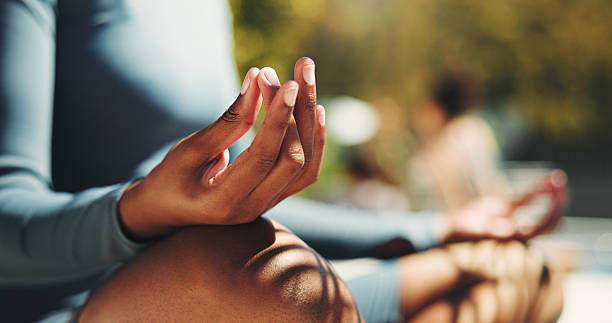
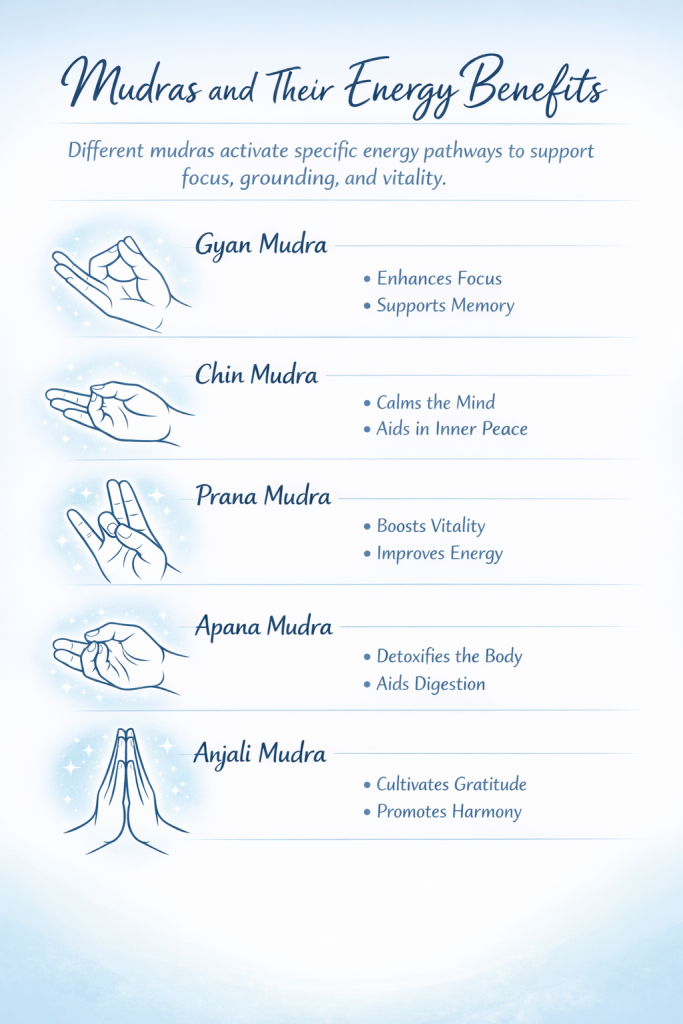
1. Gyan Mudra (Gesture of Knowledge)
How to practice:
Touch the tip of your index finger to the tip of your thumb, keeping the other fingers extended. Rest your hands on your knees, palms facing upward.
Benefits:
- Enhances concentration and wisdom
- Stimulates the air element (mental clarity)
- Supports meditation and learning
This is one of the most commonly used mudras in meditation because it promotes a state of receptivity and awareness.
2. Chin Mudra (Gesture of Consciousness)
How to practice:
Similar to Gyan Mudra, but with palms facing downward.
Benefits:
- Grounds energy into the body
- Encourages introspection
- Helps stabilize wandering thoughts
While Gyan Mudra is more expansive, Chin Mudra brings energy inward, making it ideal for deeper, more introspective meditation sessions.
3. Prana Mudra (Gesture of Life Force)
How to practice:
Touch the tips of the ring finger and little finger to the thumb, keeping the other fingers extended.
Benefits:
- Activates dormant energy
- Boosts vitality and immunity
- Balances the earth and water elements
This mudra is especially powerful when you feel depleted, fatigued, or disconnected from your body.
4. Apana Mudra (Gesture of Elimination)
How to practice:
Touch the thumb, middle finger, and ring finger together, leaving the other fingers extended.
Benefits:
- Supports detoxification
- Aids digestion and elimination
- Encourages letting go—physically and emotionally
This mudra is often associated with release, making it helpful during times of emotional processing or transition.
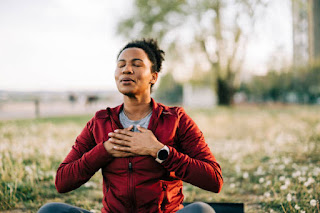
5. Anjali Mudra (Prayer Gesture)
How to practice:
Bring your palms together at the heart center.
Benefits:
- Balances left and right hemispheres of the brain
- Cultivates gratitude and connection
- Centers the mind and body
Though simple, this mudra is deeply powerful. It symbolizes unity—within yourself and with the world around you.
The Science Behind the Subtle
While mudras originate from ancient traditions, modern perspectives offer some insight into their effectiveness.
- Neuroplasticity: Repeated hand gestures paired with intention can rewire neural pathways, reinforcing specific mental states.
- Biofeedback: Mudras provide physical feedback that anchors awareness, similar to how breath awareness works.
- Somatic integration: They connect mental intention with bodily sensation, creating a more integrated experience.
In other words, mudras are not just mystical—they are practical tools for influencing your nervous system and energy simultaneously.
How to Incorporate Mudras into Your Practice
You don’t need an elaborate routine to begin working with mudras. Simplicity and consistency are far more important.
Start Here:
- Choose one mudra based on your intention (e.g., clarity, energy, grounding)
- Practice for 10–20 minutes daily during meditation
- Combine with slow, conscious breathing
- Keep your awareness on the sensation in your hands and body
Pro Tip:
Pair your mudra with a mantra or affirmation. This creates a multi-layered practice that engages the body, mind, and energy system simultaneously.
Common Mistakes to Avoid
- Overthinking the gesture: Precision matters, but don’t become rigid. Relax into the shape.
- Inconsistency: Mudras work best when practiced regularly over time.
- Lack of intention: Without awareness, a mudra becomes just a hand position. Intention activates it.
Mudras as a Daily Ritual
Beyond formal meditation, mudras can be woven into everyday life:
- Use Gyan Mudra while journaling or studying
- Practice Prana Mudra during moments of fatigue
- Hold Anjali Mudra in moments of gratitude or reflection
Over time, these gestures become anchors—quick ways to shift your state without needing a full practice.
Final Thoughts: Small Gestures, Profound Shifts
Mudras remind us that transformation doesn’t always require grand effort. Sometimes, the smallest shifts—like the placement of your fingers—can create meaningful changes in your energy, awareness, and overall well-being.
In a world that often emphasizes external action, mudras invite you inward. They offer a quiet, powerful way to connect with your body’s innate intelligence and activate energy with purpose.
When practiced with consistency and intention, these simple hand gestures become more than techniques—they become tools for self-awareness, healing, and alignment.