The Nadis Beyond the Basics: How to Work With the Body’s Energy Pathways in Yoga and Meditation
Nadis Beyond the Basics
In yogic philosophy, the human body is understood not only as a physical structure of muscles, bones, and organs, but also as a subtle system of energy and awareness. Central to this system are the nadis—the pathways through which prana, or vital life force, flows.
While many practitioners are familiar with the term, the nadis are often treated abstractly or symbolically. In reality, they are meant to be experienced directly through yoga, breathwork, and meditation. Understanding how to work with them can profoundly deepen both physical practice and meditative absorption.
This article explores the nadis beyond introductory theory and offers practical ways to incorporate them into yoga sequencing, meditation, and contemplative training.
Understanding the Nadis: A Functional Perspective
Classical yogic texts describe tens of thousands of nadis, but yoga practice focuses on how energy functions rather than on literal numbers. The nadis can be understood as pathways of sensation, breath, attention, and nervous system activity that shape how we experience the body and mind.
Rather than something to imagine, nadis are perceived through:
- Breath sensitivity
- Subtle bodily awareness
- Sustained attention
- Nervous system regulation
As awareness becomes refined, these pathways become felt as currents of ease, steadiness, warmth, or stillness moving through the body.
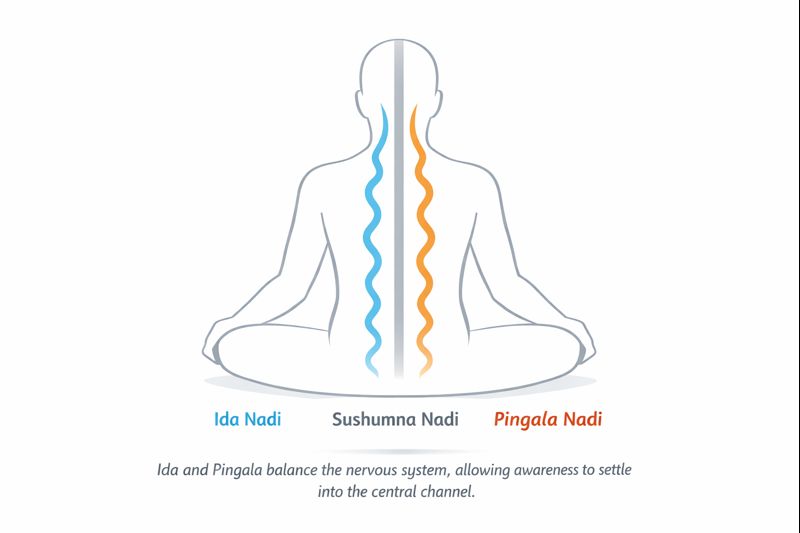
The Three Primary Nadis
Ida Nadi (Lunar Channel)
- Runs along the left side of the spine
- Associated with receptivity, intuition, rest, and emotional processing
- Linked to parasympathetic (rest-and-digest) activity
When Ida is dominant, the mind tends toward introspection and calm, though excess can feel heavy or lethargic.
Pingala Nadi (Solar Channel)
- Runs along the right side of the spine
- Associated with action, focus, heat, and outward engagement
- Linked to sympathetic (activation) energy
When Pingala is dominant, clarity and motivation increase, though excess may show up as agitation or restlessness.
Sushumna Nadi (Central Channel)
- Runs through the central axis of the spine
- Becomes active only when Ida and Pingala are balanced
- Supports deep meditation, absorption states, and insight
When awareness naturally settles into Sushumna, breath becomes subtle, the mind quiets, and meditation deepens effortlessly.
Nadis and Chakras: How They Interact
The chakras are not separate from the nadis—they are junction points where multiple nadis intersect. Each chakra represents a convergence of physical, emotional, and cognitive patterns.
- Ida and Pingala weave around the spine, crossing at each chakra
- Sushumna passes directly through the center of all chakras
When energy moves smoothly through the nadis, the chakras function coherently, supporting:
- Grounding and safety (lower chakras)
- Emotional regulation and expression (middle chakras)
- Insight and clarity (upper chakras)
Rather than “activating” chakras through force or visualization, balancing the nadis naturally harmonizes the chakra system.
Nadis and Jhana States
In advanced meditation, particularly concentration practices, balance between Ida and Pingala allows awareness to settle into Sushumna. This internal alignment creates the conditions for jhana states, characterized by:
- Unified attention
- Reduced sensory distraction
- Joy, ease, or profound stillness
- A felt sense of absorption
Importantly, jhana is not created by effortful striving. It arises when the nervous system is regulated and energy flows without obstruction.
Designing a 60-Minute Nadi-Focused Yoga Sequence
This sequence is designed to balance Ida and Pingala first, then prepare the body and mind for Sushumna-based meditation.
Phase 1: Balancing Left and Right (20 minutes)
Focus: asymmetry, gentle activation, breath awareness
- Gentle warm-up (cat/cow, pelvic tilts)
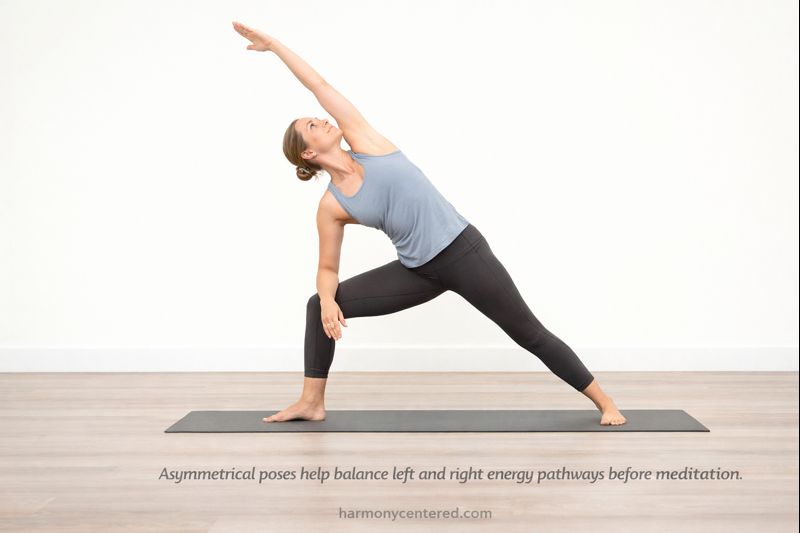
- Standing side bends (both sides)
- Warrior II → Extended Side Angle (both sides)
- Triangle pose
- Supine spinal twists
Cue awareness to notice differences between left and right sides without judgment.
Phase 2: Centralizing Energy (20 minutes)
Focus: symmetry, grounding, subtle engagement
- Forward fold (long hold)
- Seated forward fold
- Bridge or supported bridge
- Neutral seated posture
Encourage slow, even breathing and minimal muscular effort. Introduce subtle pelvic floor awareness without gripping.
Phase 3: Transition to Stillness (20 minutes)
Focus: internal awareness, preparation for meditation
- Legs up the wall or supported savasana
- Gradual transition to seated meditation
End physical practice early to preserve internal sensitivity.
Guided Meditation Script: Working With the Nadis
Begin seated, spine upright but effortless.
Bring awareness to the natural rhythm of your breath.
Notice the sensation of air moving through the nostrils without changing it.
Observe which nostril feels more open. Simply notice.
Now begin a gentle round of alternate nostril breathing:
Inhale through the left nostril.
Exhale through the right.
Inhale through the right.
Exhale through the left.
Continue for several rounds, slow and smooth, without strain.
Release the technique and return to natural breathing.
Allow awareness to rest along the central axis of the body—from the base of the spine to the crown of the head.
There is nothing to visualize. Simply feel.
As the breath becomes subtle, notice any sense of spaciousness, stillness, or ease.
Remain here, receptive and steady.
Teaching and Practice Considerations
- Nadis respond to relaxation, not force
- Sensation is more important than imagery
- Balance precedes depth
- Less technique often leads to deeper states
For students, this approach builds safety, self-awareness, and embodied insight rather than chasing peak experiences.
Closing Reflection
Working with the nadis offers a bridge between physical practice, nervous system health, and meditative depth. When yoga is approached as preparation for stillness rather than constant movement, the subtle body reveals itself naturally.
By balancing Ida and Pingala and allowing awareness to settle into Sushumna, practitioners cultivate the conditions for clarity, insight, and absorption—both on and off the mat.