Journal Prompts for Clarity for Office Workers: A Guided Set
If your workday feels like a tangle of meetings, overflowing inboxes, and decision fatigue, short moments of reflection can be a quiet lifeline. These journal prompts for clarity for office workers are designed for the mid-journey professional — not to overhaul your life, but to reset priorities, reduce reactivity, and support clearer choices in 5–20 minutes.
Use this collection as a toolkit: pick a prompt for a five-minute reset between meetings, a ten-minute check-in at lunch, or a fifteen-minute planning session before you close your laptop. Regular practice helps you notice patterns, protect boundaries, and turn insight into small, practical actions that keep you grounded and effective.
How to Use These Journal Prompts
A few simple habits make journaling at work realistic and sustainable. The aim is not to write perfectly — it’s to create rhythm and to translate reflection into one small action you can take during the day.
Why short, regular sessions work
Brief journaling bursts fit the pace of modern work life. When you write for five to ten minutes, you offload immediate worries, sharpen the next action, and reduce the mental clutter that makes meetings feel overwhelming. Those small, repeated acts of clarity compound: a quick check-in each day rewires your attention to what truly matters.
Practically speaking, short sessions are easier to protect. You’re more likely to keep a consistent habit when a practice feels doable between calendar items. This is also where office journaling prompts for focus come into play: a targeted question helps narrow attention and primes the brain to notice solutions rather than get pulled into rumination.
How to set up a 5-minute clarity ritual
A tiny ritual gives shape to the minutes you do have. The structure below keeps things simple: breathe, notice, respond, decide. The ritual is practical — and it signals to your nervous system that this is a purposeful pause, not another to-do.
Use a single prompt, set a timer, and close with one next action. The brevity forces focus and makes follow-through more likely because you leave with an immediate, low-friction step.
- Sit comfortably or stand by your desk. Take three slow breaths to settle in.
- Read the chosen prompt and write a quick, honest response (3–6 sentences or a short bullet list).
- Underline or highlight one clear next action — something you can complete in 5–20 minutes.
- Set a single timer for the action if it’s short, or add it to your calendar if it requires scheduling.
- Close with a one-sentence summary: What will make this brief effort feel worth it?

Tips for preserving privacy and continuity at the office
Decide ahead whether you’ll use digital notes or a small paper notebook. Digital tools can be quick and searchable, while paper feels private and tactile. If using a laptop, create a discreet file or a dated note that you can lock or move to a private folder. If you use a paper notebook, tuck it into a drawer or a personal bag so it isn’t on display.
Use shorthand and consistent headings to preserve continuity between sessions without needing long rewrites. Date each entry and include a one-line tag (e.g., “energy,” “decision,” “follow-up”) so you can scan past notes when you need context. Keep reflections actionable: avoid dumping raw emotion in a place that could be visible to others — instead, translate it into one next step or one boundary you’ll try.
- Use short tags and dates for easy future scanning.
- Choose a private medium (locked note file or small personal notebook).
- Write one action or boundary, not a full vent, if you’re working in shared spaces.
- Encrypt or lock digital files if they contain sensitive thoughts.
- Keep a separate ‘ideas’ note for brainstorms and a ‘log’ for decisions and actions.
Morning journal prompts for clarity for office workers
Morning journal prompts for clarity for office workers are meant to start the day with intention rather than reactivity. A short, focused entry makes it easier to protect your priorities and schedule tasks that actually move the needle.
Prompt: Today’s single intention
How-to: Name one clear intention for the day — a concise outcome or way of being (for example: ‘Complete the budget review with calm,’ or ‘Prioritize deep work for two uninterrupted hours’). Commit that intention to paper and place it where you’ll see it during the busiest hour.
Benefit: A single intention simplifies choices when distractions arise. It becomes a touchstone you can return to mid-day to re-center momentum, and it reduces the pressure of thinking you must do everything well today.

Prompt: What would make this day feel successful?
How-to: Write three concrete results that would make today feel like a win. Keep them small and specific: finish a report section, reply to priority emails, confirm next steps with two collaborators. Turn each result into a micro-task on your list.
Benefit: Framing success as specific outcomes pushes you away from vague busyness and toward measurable progress. When you can mark even small items as done, your confidence builds and decision fatigue eases.
Prompt: What’s one thing I can let go of?
How-to: Identify a task, expectation, or involvement that offers low return on time. Ask yourself: can this be delegated, deferred, or declined? If you choose to let it go, write the short script you’ll use to hand it off or postpone it.
Benefit: Naming what you can release clears mental bandwidth and reduces the ‘squeaky wheel’ effect where everything seems urgent. Letting go intentionally is a way of creating space for your highest-value work.
Prompt: Who do I need to connect with today and why?
How-to: List one or two people to reach out to and the purpose of each connection — information, alignment, or support. Add a quick note about the best channel (chat, email, brief call) and estimate time needed.
Benefit: Intentionally scheduling relationship work prevents it from becoming reactive or rushed. This prompt helps you transform loose obligations into brief, meaningful touchpoints that keep projects moving and relationships steady.
Midday prompts to regain focus
A lunchtime or mid-afternoon pause can prevent the late-day scramble and restore calm. These midday prompts help you acknowledge progress, reassess energy, and choose one clear finishing move for the day.
Prompt: What progress feels real right now?
How-to: Write a short list of 2–4 concrete things you accomplished since morning. Avoid broad statements — be specific (e.g., ‘outlined two slides,’ ‘sent follow-up to client X’).
Benefit: Recognizing real progress reduces perfectionism and shifts attention from what’s unfinished to the momentum you’ve already generated. That shift alone often restores energy and focus for the next task.
Prompt: What’s draining my energy and how can I adjust?
How-to: Name the main energy drain (a long meeting, an unclear request, a task that requires heavy concentration) and pick one immediate adjustment: a five-minute walk, a short email to clarify requirements, or batching similar small tasks.
Benefit: This diagnostic prompt converts vague malaise into actionable experiments. Small course-corrections throughout the day prevent late-afternoon depletion and keep your working rhythm sustainable.
Prompt: What’s one small task I can finish before the end of the day?
How-to: Choose a single task that is achievable and meaningful — closing a file, sending a confirmation, or drafting the first paragraph of a memo. Block a short, uninterrupted slot to finish it.
Benefit: Completing one item before leaving produces a sense of closure and sets a clear starting point for tomorrow. This tiny win reduces evening rumination and protects your off-hours from being overtaken by unfinished work.

Prompt: If I zoom out, what matters most this week?
How-to: Reconnect daily tasks to a weekly north star. Name the top one or two priorities for the week and check whether today’s plan supports them. Adjust your remaining time if needed.
Benefit: This reorientation keeps daily busyness aligned with longer-term goals, helping you avoid reactive firefighting and instead tend to strategic progress.
Decision & boundary prompts for clarity for office workers
Decision moments and boundary requests are where clarity matters most. Use these prompts before accepting new work, scheduling extra meetings, or agreeing to favors — they help you choose with intention and preserve limited time.
Prompt: What are the real criteria for this decision?
How-to: List the non-negotiable criteria the choice must meet (impact, time cost, alignment with goals, team capacity). Score the options briefly against those criteria.
Benefit: Translating values into criteria removes ambiguity and turns gut feelings into structured information. This increases the likelihood you’ll choose what advances your priorities rather than what feels immediately pleasing.
Prompt: If I said yes, what would I likely have to give up?
How-to: Identify the time, attention, or other commitments you would trade to say yes. Be concrete: which meeting, which task, or which personal time might be trimmed? Write down how you would compensate or whom you might ask to help.
Benefit: Naming the cost of yes reveals hidden trade-offs and helps you make boundaries that are sustainable. It also makes it easier to say no gracefully when the price outweighs the benefit.
Prompt: What outcome am I trying to protect by agreeing?
How-to: Reflect on the intended outcome behind your inclination to say yes — reputation, relationship-building, avoidance of conflict, or project momentum. Decide whether that outcome is best served by saying yes, offering a different contribution, or setting a boundary.
Benefit: This prompt surfaces motivations so your choices align with long-term goals rather than short-term reassurance. It reduces overcommitment and clarifies how to structure agreements in ways that protect your bandwidth.
Prompt: How will I communicate my boundary clearly?
How-to: Draft a short, respectful script you can use when declining or setting limits. Include the reason briefly and the alternative you can offer (e.g., later date, reduced scope, or a referral). Rehearse it in a sentence or two in your journal.
Benefit: Rehearsing words reduces anxiety and increases the chance your boundary will be heard without escalation. Clear communication preserves relationships and your time simultaneously.

Reflection prompts for end-of-day clarity
A brief evening reflection turns experience into learning. These prompts help you celebrate progress, notice patterns, and leave one gentle, achievable task for the next day so your mind can rest.
Prompt: What mattered most today and why?
How-to: Write one or two moments that carried meaning — a decision that moved a project, a conversation that clarified direction, or a task that felt well-executed. Note why those moments mattered to you.
Benefit: Reflecting on meaning helps you cultivate direction and reduces the sense that the day was merely busy. It highlights what to protect in future days and makes gratitude part of your professional practice.
Prompt: What did I learn about my working style?
How-to: Notice one pattern from the day — when you were most focused, what drained energy, or what interruptions repeated. Turn that observation into a small experiment for tomorrow (change timing, add a buffer, delegate differently).
Benefit: Learning about your rhythm creates a feedback loop for continuous improvement. Small, repeated experiments help you design a workweek that fits your natural attention rather than fights it.
Prompt: One micro-action for tomorrow
How-to: Choose a single, concrete action you will take first thing tomorrow — slot it on your calendar or write it on a sticky note. Make it specific and tiny enough that you can complete it without friction.
Benefit: A micro-action reduces morning decision paralysis and creates momentum for the day. It ties reflection to forward motion so you wake with purpose rather than an open-ended to-do list.
Next steps, templates, and a printable worksheet
If you’re ready to commit to a short experiment, the tools below make it easy to begin. Use the templates to slot journaling into your regular day and try a 7-day experiment to notice real shifts.
5/10/15-minute session templates
How-to: Choose a template that fits the time you have. The 5-minute version is a focused check-in (one prompt + one action), the 10-minute version allows for two prompts and a short plan, and the 15-minute version supports a brief review plus scheduling and drafting a message or task. These quick structures remove the decision of ‘how’ so the practice can actually happen.
Benefit: Pre-built templates reduce friction and make journaling a repeatable habit. They also ensure each session ends with a tangible next step rather than an open-ended feeling that encourages procrastination.
- 5-minute: One prompt, three quick bullets, one highlighted next action.
- 10-minute: Two prompts, a brief pros/cons note if needed, and a three-step plan.
- 15-minute: One reflective prompt, one planning prompt, and scheduling of one calendar item.
7-day clarity experiment
How-to: Commit to one short journaling session per workday for seven days. Follow this simple schedule: Day 1 morning intention, Day 2 midday reset, Day 3 decision clarity, Day 4 end-of-day reflection, and repeat with small adjustments. Track mood, focus, and one measurable outcome (e.g., fewer open tasks at day’s end).
Benefit: A focused, time-limited experiment makes it easier to notice change. After seven days you’ll see whether the practice supports better decisions, calmer transitions, or clearer priorities — and you can refine the prompts you return to most.
- Day 1: Morning intention (5–10 minutes).
- Day 2: Midday check-in (5 minutes).
- Day 3: Decision prompt before saying yes (5–10 minutes).
- Day 4: End-of-day reflection (10 minutes).
- Day 5–7: Repeat chosen prompts and note patterns; summarize on Day 7.
Printable worksheet (downloadable)
What’s included: a two-page worksheet that groups the prompts (morning, midday, decision, evening), provides three session templates (5/10/15 minutes), and includes a 7-day habit tracker so you can notice progress. Use the habit tracker to mark each completed session and jot one line about what shifted.
How to use it: Print and keep it near your workspace or save it to your device. Treat it as a living document — circle the prompts that resonate, cross out the ones that don’t, and customize the templates to fit your rhythm. The worksheet is meant to reduce friction and make the experiment gentle and doable.
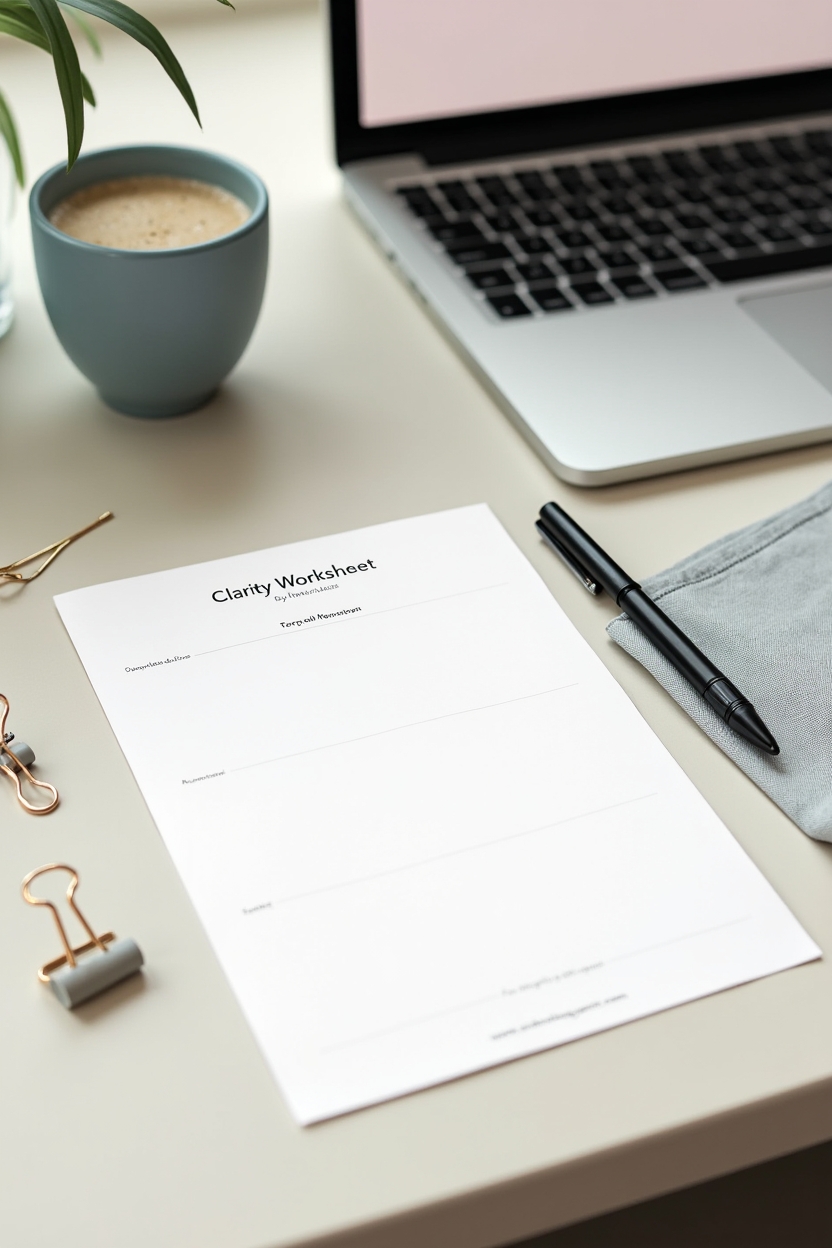
Download the 2-Page Clarity Worksheet
A printable two-page worksheet with grouped prompts, 5/10/15-minute session templates, and a 7-day habit tracker to help you try journal prompts for clarity for office workers in a simple, structured way. Use it to start a gentle experiment and build a journaling habit that supports focus and boundaries.
Get the Worksheet
Final Thoughts
Clarity at work isn’t a single insight — it’s a practiced habit of noticing, naming, and choosing. These journal prompts for clarity for office workers are small supports to help you make decisions with less friction and more heart. Try a few, keep what helps, and remember: clarity is practiced, not perfected.
If you’d like next steps, consider pairing these prompts with a short daily meditation for focus or a simple boundary-setting script to use at meetings. Gentle experiments create lasting change — one five-minute pause at a time.