Natal vs. Transit Aspects: Mastering 2026’s Cosmic Shifts
2026 is bringing major cosmic shifts. This is the year slow-moving outer planets dramatically reshape the collective landscape: Neptune enters Aries for the first time in over 150 years, Pluto settles into Aquarius long-term, and Saturn moves into Aries. These transits will influence everything from global trends to your daily moods.
But what does it mean for your birth chart?
In this guide, you’ll learn the difference between natal aspects (the angles in your birth chart) and transit aspects (current planetary movements interacting with your chart). You’ll also learn how to interpret both, with clear definitions, examples, and practical tips. By the end, you’ll be equipped to navigate 2026’s celestial energy—from Neptune’s dreamy new vibe to Pluto’s transformational intensity—and understand what it means for you.
Let’s dive in.
Natal vs. Transit Aspects: What’s the Difference?
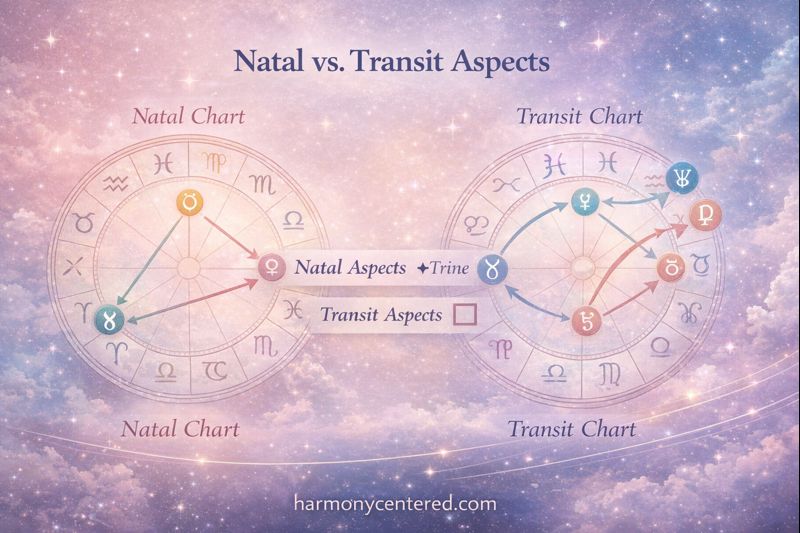
An aspect is simply the angle between two planets as seen from Earth. Natal and transit aspects both involve planetary relationships, but they operate on different timelines:
Natal Aspects
These are the angles between planets in your birth chart. They form a permanent energetic blueprint that shapes your personality and life themes.
For example, a trine (120°) between your Sun and Moon often creates natural emotional harmony. Natal aspects are essentially who you are—your cosmic DNA.
Transit Aspects
These occur when current planetary positions form aspects to your natal planets. Transits are temporary influences—cosmic weather that triggers events or feelings during a specific time.
For example, a Mars square Mercury transit may bring heated conversations or mental stress for a few days or weeks. Once Mars moves on, the intensity fades.
In short:
- Natal aspects show your inherent strengths and patterns.
- Transit aspects show when those patterns are activated or challenged.
How to Read Natal Aspects
Your birth chart is a snapshot of the sky at the moment you were born. The angles between planets reveal how different parts of your psyche interact.
1. Learn the Major Aspect Types
The five major aspects are:
- Conjunction (0°): Blended energies
- Sextile (60°): Opportunity and cooperation
- Square (90°): Tension and challenge
- Trine (120°): Ease and talent
- Opposition (180°): Polarity and relationship dynamics
2. Identify the Planets Involved
Each planet has a unique role.
For example:
- Sun–Saturn often represents discipline and self-mastery
- Venus–Mars reflects charm, attraction, and creative drive
3. Consider Sign and House
An aspect’s flavor changes depending on the signs and houses involved.
A square between Aries and Cancer will feel different than a square between Libra and Capricorn, for example.
4. Look at Orb (How Tight the Aspect Is)
A tight aspect (1–2° orb) is strong and central to your personality.
A loose aspect (8–9° orb) is more subtle.
5. Synthesize the Story
Look for patterns like a T-square, Grand Trine, or Stellium.
These patterns reveal deeper themes and life direction.
Example: Reese Witherspoon’s Natal Drive
Reese Witherspoon’s chart shows a Sun–Mars square. This often creates inner tension between identity and drive. In Reese’s case, Mars is in Cancer, which softens the energy. Her drive becomes protective and nurturing rather than aggressive.
This aspect likely contributes to her strong ambition, leadership, and emotional sensitivity—especially in roles that blend strength with vulnerability.
Working with Transit Aspects: Timing is Everything
If natal aspects are your astrological DNA, transit aspects are the weather.
1. Track the Planets
Use an ephemeris or transit calendar to monitor planetary movements. Note major dates like:
- Neptune enters Aries — Jan 26, 2026
- Saturn enters Aries — Feb 13, 2026
2. Identify Transit Aspects
Compare transiting planets to your natal chart. Conjunctions, squares, and oppositions are the most impactful. Trines and sextiles bring ease and opportunity.
3. Know the Nature of the Planet
Each planet has a distinct energy:
- Saturn: responsibility, structure, discipline
- Neptune: dreams, spirituality, illusion
- Pluto: transformation, power, rebirth
- Jupiter: growth, expansion
- Mars: energy, action
- Venus: relationships, values
- Mercury: communication
- Uranus: surprise, innovation
4. Consider the Aspect Type
A Saturn square feels very different from a Saturn trine.
Exact aspects are usually when the peak of the transit occurs.
5. Blend Transit with Natal Context
A transit to your Moon affects emotions and home life, while a transit to your Midheaven impacts career and public life.
Example: Saturn’s Test and Reward
If your natal Venus is at 5° Cancer, Saturn in Aries will square it during 2026–27. This transit often brings relationship challenges or financial restructuring.
The reward? If you handle Saturn’s lessons with patience and discipline, you build lasting stability and maturity.
Major Transits of 2026 and What They Mean
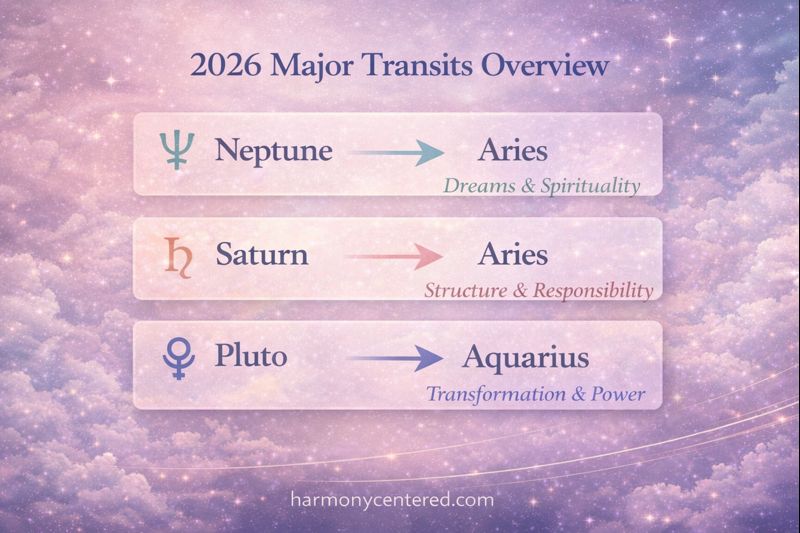
2026 is a landmark year because Neptune, Saturn, and Pluto are all shifting in major ways. Here’s what to expect.
Neptune in Aries (2025–2039): A New Spiritual Frontier
Neptune moves from dreamy Pisces into bold Aries, creating a new era of inspired identity and visionary self-expression.
Positive potential:
- Increased creativity
- Spiritual awakening
- Bold new dreams
Watch for:
- Identity confusion
- Escapism
- Unrealistic expectations
If Neptune conjuncts your Sun, you may feel more sensitive and spiritually curious. This transit is best used for creative work, meditation, and soul exploration—paired with grounding practices.
Saturn in Aries (2025–2028): Building New Foundations
Saturn’s transit through Aries brings serious growth. It’s a time of responsibility, maturity, and real-world results.
Expect:
- Increased pressure to perform
- Career milestones
- Greater accountability
Saturn demands discipline, but it also builds lasting success.
Pluto in Aquarius (2024–2043): Collective Transformation
Pluto’s long-term shift into Aquarius is one of the most powerful collective transits in generations.
It brings transformation to:
- Technology
- Social networks
- Community and humanitarian movements
- Group power dynamics
On a personal level, Pluto transits can trigger deep rebirth and identity shifts, especially if you have early degrees in Aquarius, Leo, Taurus, or Scorpio.
Putting It All Together
Astrology is most powerful when you combine natal insights with transit timing. Natal aspects reveal your core blueprint. Transit aspects reveal when that blueprint is activated, challenged, or rewarded.
In 2026, the major theme is:
Dreams + Discipline + Transformation.
- Neptune in Aries: inspired vision
- Saturn in Aries: practical action
- Pluto in Aquarius: deep transformation
If you want to explore this further, join our community for monthly transit guides, advanced tutorials, and personalized astro insights.
Your cosmic journey is just beginning. 2026 is the year to step fully into your power.